

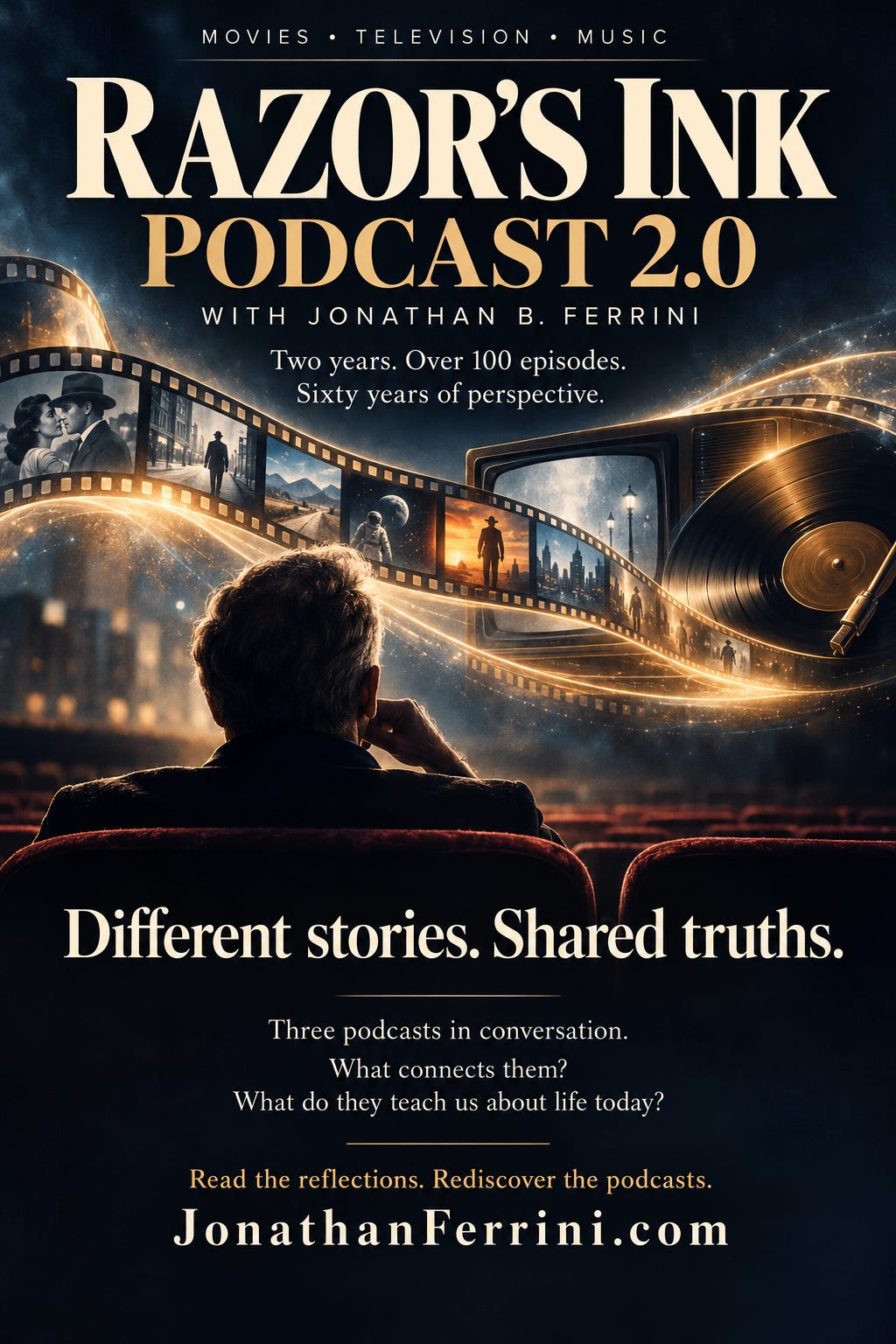
After two years of podcasting about film, television, and music, I’ve come to recognize that some of the most meaningful lessons emerge when seemingly unrelated works are considered together. Three podcasts that I produced about physicians in film, television producer and actor Jack Webb, and singer Trini Lopez share a common thread: the importance of looking beyond the labels society attaches to people and recognizing the human being underneath.
In my podcast Physician as Protagonist and Moral Compass in Film, I reflect on David Lean’s The Bridge on the River Kwai and Doctor Zhivago. These films remind us that professional titles, institutions, and obligations don’t necessarily define a person’s moral character. The physician becomes more than a practitioner of medicine. He represents conscience, humanity, and the difficult choices individuals face when personal convictions collide with authority. A uniform may identify one’s position in society, but it cannot tell us everything about the person wearing it.
My podcast Who Was Jack Webb? examines a man whose public identity became inseparable from Sergeant Joe Friday of Dragnet. Yet Webb was far more than the stern, seemingly humorless detective familiar to generations of television viewers. He was a creative force who helped shape American television, including Adam-12 and Emergency! Behind the familiar image was a complex individual with artistic ambitions, convictions, and an enduring influence on popular culture. His career demonstrates how easily we confuse the characters people portray with the people they actually are.
Then there is Who Is Trini Lopez?, my podcast about the Mexican-American entertainer whose music crossed cultural boundaries and reached audiences around the world. Lopez’s success is particularly meaningful when considered against the social expectations and ethnic stereotypes of his generation. His talent, personality, and determination allowed him to establish an identity that transcended the categories into which others might have placed him. His story reminds us that artistic achievement knows no ethnic or cultural boundaries, even when society insists upon creating them.
What connects these three podcasts is the danger of allowing labels to become substitutes for understanding.
And that brings me to life in America in 2026.
We live in a society increasingly inclined to classify people before getting to know them. Political affiliation, ethnicity, occupation, education, economic circumstances, age, and even geography have become convenient ways of deciding who someone is and what they must believe.
These labels may provide a quick description, but they rarely tell the complete story.
Social media reinforces this tendency, encouraging instant judgments based on fragments of information. We encounter an opinion, recognize a political position, or identify someone’s background and too often conclude that we know everything necessary about that individual.
But people are considerably more complicated than the categories we assign them.
A person may hold political beliefs different from our own and still possess extraordinary kindness. Someone whose formal education was limited may have acquired wisdom through experiences no university could provide. An individual whose background seems entirely foreign to us may share our most fundamental hopes, fears, disappointments, and aspirations.
As I grow older, I find myself less interested in the labels people carry and increasingly curious about the experiences that shaped them.
What disappointments changed their lives? What sacrifices did they make? What dreams did they abandon? What kindnesses did they receive or extend to others when nobody was watching?
These are the questions that reveal character. They require conversation, patience, and a willingness to listen without immediately passing judgment.
I don’t believe we must abandon our convictions or pretend that differences don’t matter. They do. But understanding another person’s humanity does not require agreement with their opinions. It simply requires recognizing that no single characteristic can adequately describe an entire life.
Film, television, and music have spent generations introducing us to people whose circumstances differ from our own. At their best, these artistic expressions allow us to experience the world through someone else’s eyes.
Perhaps that’s one reason they have remained so important to me throughout my life.
The physician confronting moral responsibility, the television personality whose public image concealed a far more complicated individual, and the entertainer who transcended cultural expectations each offer a variation on the same lesson.
A label may tell us where to begin understanding someone, but it should never be where our understanding ends.
At a time when society seems increasingly divided into competing identities, perhaps one of the most meaningful things we can do is rediscover our curiosity about one another.
Before deciding who someone is, we might begin by asking who they are.
And then take the time to listen.
Two Years. Ninety-Five Podcasts. Sixty Years of Film, Television, and Music.
What began as a personal exploration of the films, television programs, and music that have accompanied me throughout my life has become something more: an opportunity to reconsider what these works have taught me about people, relationships, society, and the passage of time.
I invite you to explore the complete collection of Razor’s Ink Podcast episodes, where six decades of watching, listening, and reflecting continue to offer new perspectives on the world we inhabit today.
Listen to the Three Podcasts
Available on RSS.com and Substack
1. FILM — Physician as Protagonist and Moral Compass in Film
Exploring humanity, conscience, and individual moral responsibility through David Lean’s The Bridge on the River Kwai and Doctor Zhivago.
Listen on RSS.com:
https://rss.com/podcasts/razorsink/1371028/
Listen on Substack:
https://www.jonathanferrini.com/p/physician-as-protagonist-and-moral
2. TELEVISION — Who Was Jack Webb?
Looking beyond Sergeant Joe Friday to discover the actor, producer, and creative force behind some of American television’s most enduring programs.
Listen on RSS.com:
https://rss.com/podcasts/razorsink/1572520/
Listen on Substack:
https://www.jonathanferrini.com/p/who-was-jack-webb
3. MUSIC — Who Is Trini Lopez?
The remarkable story of a Mexican-American entertainer whose talent and determination transcended cultural labels and captivated audiences.
Listen on RSS.com:
https://rss.com/podcasts/razorsink/1430931/
Listen on Substack:
https://www.jonathanferrini.com/p/who-is-trini
Explore the Complete Razor’s Ink Podcast Collection
Substack: www.jonathanferrini.com
RSS.com:
https://rss.com/podcasts/razorsink/
Jonathan B. Ferrini
Razor’s Ink Podcast 2.0